The One Fabric Weight Mistake That Makes Transitional Layering Fail Every Time

Quick Answer: The most common transitional layering failure is stacking similar-weight fabrics together (a medium sweater over a medium shirt under a medium jacket), which creates bulk without proportional warmth — effective layering pairs contrasting weights, thin against thick, so each layer does a distinct job instead of duplicating the one next to it.
You put on three reasonable pieces and still end up either sweating indoors or cold the second you step outside. The pieces were fine. The stacking order was the actual problem.
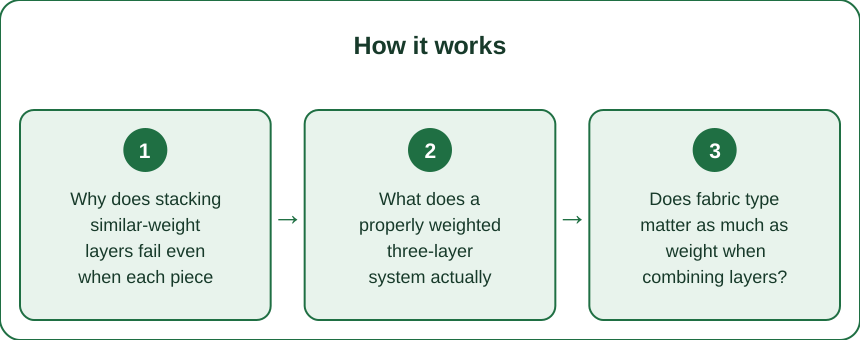
Why does stacking similar-weight layers fail even when each piece is good quality?
Each layer in a system is supposed to serve a distinct function — moisture management, insulation, or wind/weather protection — and stacking two medium-weight pieces means both are trying to do the insulation job while nothing handles the other functions well. The result is often bulkier and paradoxically less warm than a well-chosen thin-plus-thick combination, because two similar mid-weight layers trap less usable air (the actual source of warmth) than one thin layer plus one genuinely insulating one.
What does a properly weighted three-layer system actually look like?
A thin, close-fitting base layer, a genuinely insulating mid layer (not just another shirt), and a lighter shell or jacket on top is the structure that actually works — each layer contrasts in weight and function with the one next to it rather than duplicating it. This is standard outdoor-gear logic applied to everyday transitional dressing, and it’s the main reason a $40 well-chosen combination often outperforms three expensive but similarly-weighted pieces.

Does fabric type matter as much as weight when combining layers?
Yes — a base layer that doesn’t wick moisture (like heavy cotton) undermines the whole system regardless of what’s layered on top, since trapped moisture against skin cools you faster once you stop moving or step outside. Weight and fabric type work together: getting the weight contrast right with the wrong fabric type still produces a system that fails in specific conditions, particularly moving between warm indoor spaces and cool outdoor air repeatedly.
What Nobody Tells You About Layering for 30-Degree Temperature Swings
The goal isn’t finding pieces that are comfortable at every temperature in the swing — it’s building a system you can remove pieces from as the day warms, which means every layer needs to work as a standalone piece, not just as part of the stack. A mid layer that looks unfinished worn alone isn’t actually doing its job in a true transitional system, since removing the outer layer mid-day is the entire point of dressing this way.
FAQ: Transitional Layering Fabric Weight Questions, Answered
How many layers is actually optimal for a 30-degree swing?
Three is generally the sweet spot for most transitional weather — fewer than that struggles to cover the full range, and more than that usually adds bulk without adding proportional flexibility.
Should the thickest layer go on the outside or in the middle?
The middle, in most systems — the outer layer’s job is often wind or light rain protection more than pure insulation, so a lighter shell over a genuinely thick mid layer typically outperforms a thick coat over a thin sweater.
Does this same weight-contrast principle apply to layering at the ankle and neck, not just the torso?
Yes — a heavy scarf over a heavy turtleneck creates the same bulk-without-benefit problem as torso layering, and contrasting weights there follows the identical logic.
TL;DR:
- Stacking similar-weight layers creates bulk without proportional warmth
- A proper system contrasts weights: thin base, genuinely insulating mid, lighter shell
- Fabric type (moisture-wicking especially) matters as much as weight itself
- Every layer should work as a standalone piece, since removing one mid-day is the point
Transitional layering rarely fails because of the pieces themselves — it fails because those pieces were stacked without a plan for what each one was actually supposed to do.
Keep Reading
This article is for general informational and styling purposes only. Fit, sizing, and product availability may vary.