Why Humidity, Not Temperature, Decides Which Transitional Layers Actually Work

Quick Answer: Your body cools primarily by evaporating sweat, and evaporation slows dramatically as humidity rises. A humid 68F day feels warmer and stickier than a dry 68F day, and layers that trap moisture become uncomfortable much faster. In humid transitional weather, prioritise breathable single layers and open weaves; in dry transitional weather, prioritise layer count and wind resistance. Check the dew point rather than the humidity percentage - it is the more useful number.
The same outfit that was perfect on Tuesday was miserable on Thursday, at the same temperature.
The thermometer was identical. The air was not.

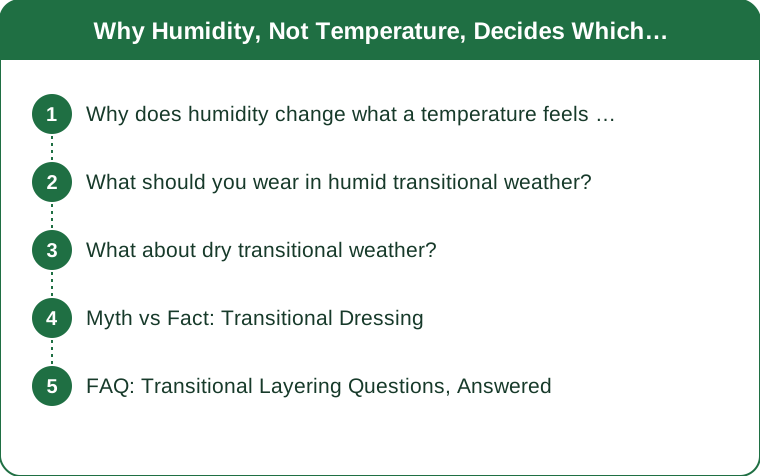
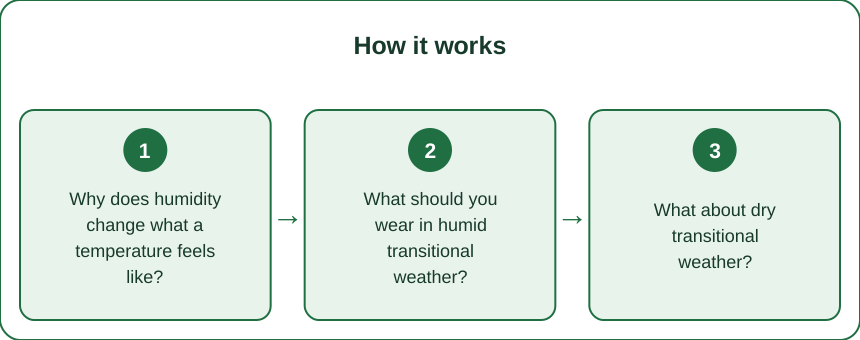
Why does humidity change what a temperature feels like?
Your body sheds heat largely by evaporating sweat from the skin, and evaporation requires the surrounding air to be able to accept more moisture.
High humidity means the air is already close to saturated, so evaporation slows and the cooling mechanism becomes less effective.
Which is why 68F and humid feels warmer and stickier than 68F and dry, even though the thermometer agrees.
In dry air, evaporation is fast and cooling is efficient, so the same temperature feels crisp and you can wear more without overheating.
Dew point is the more useful number than relative humidity, because it reflects the actual moisture content of the air rather than a percentage of a temperature-dependent maximum.
A dew point below about 55F generally feels comfortable; above 65F feels muggy to most people regardless of the actual temperature.
And this is the missing variable in most transitional dressing advice, which treats temperature as the only input.
What should you wear in humid transitional weather?
Fewer layers, more breathability. Layer count is the wrong lever when evaporation is already the bottleneck.
Open weaves and loose structures - linen, loose cotton, open-knit cardigans - let moisture move.
Avoid anything that traps a still air layer against the skin, which is exactly what makes a fleece or a lined jacket unbearable at a mild humid temperature.
Choose a single mid-weight piece over two light ones, because each layer boundary is another place moisture gets stuck.
Skip the trapping outer shell unless it is raining - a wind-resistant layer prevents both wind and evaporation.
Prioritise a top you can push up or roll, since the arms are where most people overheat first.
And expect your morning outfit to fail by afternoon on humid days more than dry ones, because the day warms and the air’s capacity to take moisture does not improve proportionally.
What about dry transitional weather?
Layer count works here, because evaporation is efficient and trapped moisture is much less of a problem.
Wind resistance becomes the priority, since dry air plus wind removes heat rapidly.
Three light layers outperform one heavy one, because you can adjust across a large daily swing.
Dry cool mornings and warm afternoons produce the biggest swings of the year, frequently 20F or more, which is exactly what layering is for.
Fabric weight matters more than layer count when it is dry and cold; layer count matters more when it is dry and mild.
Add a scarf rather than a heavier coat for the morning-only portion of the swing, since it removes easily and packs small.
And carry rather than wear. The bag is the actual transitional layering tool on dry-swing days.
Myth vs Fact: Transitional Dressing
Myth: temperature tells you what to wear. Fact: it tells you half. Humidity determines whether your cooling mechanism works, which is why identical temperatures can demand completely different outfits.
Myth: more layers is always more adaptable. Fact: in humid conditions, each additional layer boundary traps moisture and reduces evaporation. Fewer, more breathable layers adapt better when the air is damp.
Myth: relative humidity is the number to check. Fact: dew point is more useful, because relative humidity is a percentage of a temperature-dependent maximum and can be high on a genuinely comfortable cool morning.
Myth: natural fibres always breathe better. Fact: linen and open-weave cotton breathe excellently, but tightly woven cotton can be less breathable than a technical knit designed for moisture transport. Construction matters as much as fibre.
Myth: you should dress for the middle of the day. Fact: dress for the coldest point you will be outside and carry the difference. Being cold at 8am is a real problem; carrying a light layer at 2pm is not.
Myth: a rain shell is a good general outer layer. Fact: it blocks both wind and evaporation, which makes it excellent in rain and clammy on a mild humid day. Keep it for actual rain.
FAQ: Transitional Layering Questions, Answered
Why does the same temperature feel so different day to day?
Humidity. Your body cools by evaporating sweat, and humid air slows that process, so the same temperature feels warmer and stickier.
What number should I check besides temperature?
Dew point. Below about 55F is comfortable; above 65F feels muggy regardless of the thermometer.
Should I layer more or less in humid weather?
Less, and more breathable. Layer boundaries trap moisture, which is the exact problem humid air creates.
What works best on big dry temperature swings?
Three light layers rather than one heavy one, plus a scarf for the morning portion. Carry what you are not wearing rather than committing to it.
Why does my morning outfit fail by afternoon?
Because you dressed for the temperature at the coldest moment and the day warmed. Dress for that cold moment anyway and plan to shed - the reverse is worse.
Is a rain jacket a good transitional layer?
Only in rain. It blocks evaporation as well as wind, which makes it clammy on mild humid days.
TL;DR:
- Your body cools by evaporation, which slows sharply as humidity rises.
- A humid 68F and a dry 68F demand genuinely different outfits.
- Check dew point, not relative humidity - below 55F is comfortable, above 65F is muggy.
- Humid: fewer, more breathable layers with open weaves.
- Dry: more layer count, more wind resistance, and a scarf for the morning portion.
- Save the rain shell for actual rain - it blocks evaporation as well as wind.
Dress for the coldest moment you will be outside and carry the rest.
Keep Reading
This article is for general informational and styling purposes only. Fit, sizing, and product availability may vary.