Why the First Cold Morning of the Year Catches Out Even Organized People

Quick Answer: The first cold morning typically arrives two to three weeks before most people switch their wardrobe, because the switch is triggered by a sustained pattern and the first cold day is a single event. Build a small transition set of six pieces you keep accessible from early September, and the first cold morning stops being a problem.
Every year it happens, and every year it feels like an oversight.
The forecast said 8C and you owned nothing between a summer outfit and a winter one that was still in a box.
This is not a planning failure. It is a mismatch between how weather arrives and how wardrobes change.

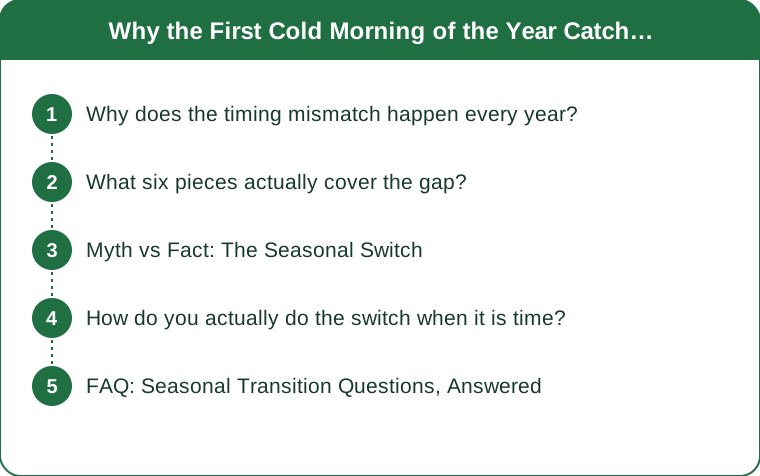
Why does the timing mismatch happen every year?
Because wardrobe changes are triggered by patterns and weather arrives as events.
You switch your wardrobe when it has been cold for a while — when the pattern is established enough to justify the effort of moving boxes and rearranging a rail. That is a rational threshold and it takes a week or two of consistent cold to cross.
The first cold morning does not wait for the pattern. In most temperate climates, autumn arrives as a series of single cold days separated by warm ones, and the first of those typically lands two to three weeks before the sustained cold does.
So there is a reliable, annual window where the weather has already produced a cold day and your wardrobe is still configured for the average. The gap is structural, and the solution is not to switch earlier — switching earlier just moves the problem to the warm days in between.
What works instead is a small standing set that covers the gap without requiring a full changeover.
What six pieces actually cover the gap?
Keep these accessible from the first week of September, regardless of what the weather is doing.
One mid-weight knit. Not a chunky winter sweater and not a summer-weight top. Merino or a fine cotton knit that works over a tee and under a jacket.
One pair of full-length trousers or jeans in a weight you would wear at 10C. Most people have summer-weight and winter-weight and nothing in between.
One closed shoe. A loafer, a low boot, or a sneaker you would wear with socks. The shoe is the piece people forget, and cold feet are what actually make a marginal outfit feel wrong.
One scarf. The highest-value item in the set by a wide margin. A scarf converts a summer outfit into a cold-morning one with no other changes, and it is removable when the day warms up.
One light jacket. Unlined or lightly lined, ideally with a collar. This is the piece that handles 8 a.m. and comes off at 11.
One pair of proper socks. Trivial, and the single most common gap in an otherwise complete transition set.

Myth vs Fact: The Seasonal Switch
Myth: You should switch your wardrobe on a fixed date. Fact: Fixed dates fail in both directions in a variable autumn. A standing transition set makes the date irrelevant, which is why it works better than any calendar rule.
Myth: Layering means wearing more thin things. Fact: Effective layering is about function per layer — moisture next to skin, insulation in the middle, wind resistance outside. Three thin cotton layers do one job three times and none of the others.
Myth: You need transitional-specific clothing. Fact: Almost every piece in the six above is something you already own or would buy anyway. Transitional dressing is a matter of accessibility and combination rather than a separate category of garment.
Myth: The morning outfit should work all day. Fact: On a transition day it cannot, and trying to make it costs you comfort at both ends. Build the outfit to shed a layer at 11 and regain it at 5.
How do you actually do the switch when it is time?
In two stages rather than one, about three weeks apart.
Stage one, early September: bring the six transition pieces forward and put the most summer-specific items — the thinnest dresses, the sandals, anything sleeveless — into the back rather than into storage. Do not move any boxes yet. This takes fifteen minutes.
Stage two, when the pattern is established: do the real changeover. By now you know what you have actually been reaching for, which makes decisions about what to store much easier and much more accurate than doing it in one pass in August.
The two-stage version also catches a common problem. Doing a single full switch means you decide what to store while it is still warm, which is when you consistently overestimate how much summer clothing you will want next year and underestimate the transitional pieces.
One addition worth making at stage two: put the six transition pieces somewhere you will find them next September rather than distributing them back into general storage. Future you will spend twenty minutes looking for the scarf otherwise, on the exact morning it is needed.
FAQ: Seasonal Transition Questions, Answered
How cold does it need to be before the transition set is enough?
The six pieces handle roughly 6 to 15C comfortably, which covers most of the autumn transition in temperate climates. Below 6C sustained, you are into the real winter wardrobe.
What if my mornings and afternoons differ by 12 degrees?
That is a normal autumn spread and it is exactly what the removable layers are for. Plan the outfit around the afternoon and add the scarf and jacket for the morning, rather than the reverse.
Should I store clothes by season or keep everything out?
If you have the space, keeping everything accessible avoids this problem entirely. If you do not, the two-stage switch with a standing transition set is the next best thing and takes very little effort.
TL;DR:
- The first cold day arrives two to three weeks before sustained cold, and wardrobes switch on the pattern rather than the event.
- Keep six pieces accessible from early September: mid-weight knit, real trousers, closed shoes, scarf, light jacket, proper socks.
- Switch in two stages — a fifteen-minute reshuffle in early September, the full changeover once the pattern holds.
- Store the transition set together so it is findable next year.
Nobody is disorganized in the specific way this problem makes them feel. The weather simply arrives on a different schedule than the wardrobe does, and six accessible pieces close a gap that otherwise reopens every single autumn.
Keep Reading
This article is for general informational and styling purposes only. Fit, sizing, and product availability may vary.