How to Build a Three-Piece Outfit That Works Across a 20-Degree Day

Quick Answer: Pick a base you would be comfortable in at the day’s high, a mid layer sized to fit under the outer layer, and an outer piece that packs or ties without bulk. The critical rule is that each piece must look intentional worn alone, because you will spend part of the day in each configuration. Most transitional outfits fail not because they are the wrong warmth but because the base layer looks like underwear once the other two come off.
Early September to mid October is a 20-degree daily swing in much of the country, and it is one outfit, not three.
This blog has covered why your morning outfit is wrong by 3pm in early fall, why the same layers work in spring and fail in fall, why transitional outfits feel wrong even when warm enough, and why a 20-degree daily swing is the hardest week to dress for. This is the actual formula.

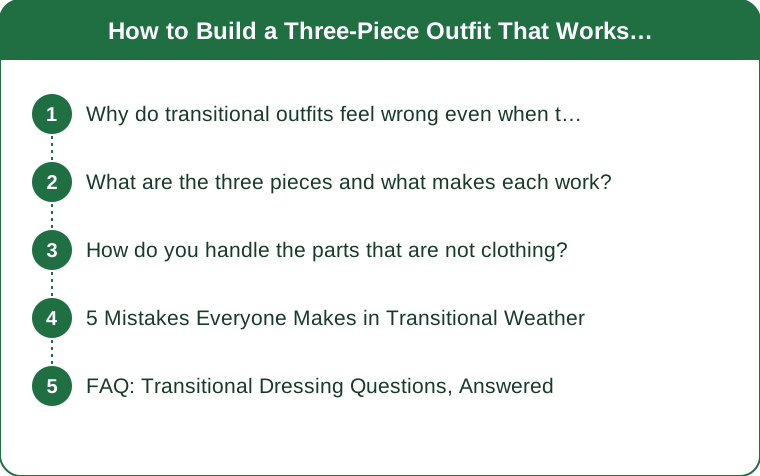
Why do transitional outfits feel wrong even when they are warm enough?
Because comfort and looking right are separate problems, and layering solves one while frequently breaking the other.
Each configuration has to stand on its own. You will be wearing three pieces at 8am, two at noon, and one at 3pm. If the one-piece version looks like you are half dressed, the outfit fails for a third of the day regardless of temperature.
Proportion changes as you remove layers. A jacket adds visual width at the shoulders and structure at the waist. Take it off and the silhouette underneath can suddenly read as shapeless, which is the specific feeling people describe as an outfit being wrong.
Fabric weight tells the season, not just temperature. A summer-weight cotton tee under a wool coat reads as mismatched even when the combination is thermally correct. The eye picks up seasonal weight, and the mismatch is what feels off.
Colour also carries seasonal information. Bright summer brights under an autumn outer layer create the same dissonance. Shifting the base palette earlier than you shift the fabric weights is a common transitional fix.
And carrying removed layers is part of the outfit. A jacket in your hand or tied at your waist is a visible component. If it bunches, drags, or has to be carried folded over an arm all afternoon, the outfit is worse than it looked in the mirror.
So the design constraint is: three pieces that work in three combinations, and one of them has to be carryable.
What are the three pieces and what makes each work?
One base, one mid, one outer, each with a specific requirement.
Base: comfortable at the day’s high, and complete on its own. A good quality tee, a fine-knit short-sleeve, or a sleeveless top with an actual neckline rather than a plain scoop. The test is whether you would leave the house in it alone. If not, it is underwear, not a base layer.
Base fabric should already read autumnal. A slightly heavier cotton, a fine merino, or a modal blend rather than a thin summer jersey. Same temperature performance, different visual weight.
Mid: warmth without bulk, and sized to fit under the outer piece. A fine-gauge cardigan, a lightweight knit, or an overshirt. The commonest failure is a mid layer too bulky for the jacket, which means you can never wear all three at once and you have effectively bought a two-piece system.
Mid should also work as an outer piece on its own. An open cardigan over the base is the noon configuration and it should look deliberate.
Outer: wind resistance and packability over warmth. In a 20-degree swing, the outer layer is on for maybe an hour and carried for six. A structured jacket that ties at the waist or a light trench works; a bulky puffer does not.
And check the three lengths against each other. The mid should not hang below the outer, and the base should not extend past the mid unless you intended it to. This is the single most common visual failure in layered outfits and it is entirely fixable at the point of choosing.

How do you handle the parts that are not clothing?
Shoes, bag, and accessories all carry seasonal weight and all are frequently left behind on summer settings.
Shoes are the strongest seasonal signal and the last thing people change. Sandals under an autumn outfit is the classic transitional error. A closed loafer, a low boot, or a leather trainer immediately shifts the whole outfit into the right season.
Socks become visible again, so they become a decision. Autumn is when sock choice starts contributing to the outfit rather than being invisible, and it is worth a moment of thought.
A bag that can hold the outer layer is genuinely useful. A tote that swallows a packed jacket saves you carrying it for six hours. This is a practical rather than aesthetic consideration and it changes how the day feels.
A scarf is the highest-value transitional accessory because it adds real warmth at low bulk, packs to nothing, and shifts the seasonal register immediately. In a 20-degree swing it is often more useful than the jacket.
Jewellery and metals shift slightly too. Whatever felt right in July often reads as summery in October, and swapping to something with more visual weight is a small change with a disproportionate effect.
And check what the sun is doing at your commute times. Early autumn mornings and evenings both have low sun angles, which is why sunglasses stay relevant even as the temperature drops, and why a light-coloured outfit can be dazzling at 6pm in a way it never is in midsummer.
5 Mistakes Everyone Makes in Transitional Weather
1. Dressing for the morning temperature. You are outside for perhaps twenty minutes at the low and several hours at the high. Dress for the high and add a removable layer for the twenty minutes.
2. A base layer that is not a complete garment. The thing you are wearing at 3pm is the thing you chose as an underlayer at 8am, and if it looks like underwear, a third of your day looks wrong.
3. A mid layer too bulky to fit under the outer. This turns a three-piece system into two separate two-piece systems and you lose the coldest configuration entirely.
4. Keeping summer shoes. The fastest way to make a transitional outfit look confused is autumn clothing above and July shoes below. Shoes carry more seasonal weight than any other single piece.
5. Choosing an outer layer that cannot be carried. It will be off your body for most of the day. If it does not pack, tie, or fit in your bag, you will either leave it at home or spend the afternoon holding it.
FAQ: Transitional Dressing Questions, Answered
How do you dress for a 20-degree temperature swing?
Three pieces: a base you would wear alone at the day’s high, a mid layer sized to fit under the outer, and a packable outer piece. Each must look intentional worn alone, since you will spend part of the day in each configuration.
Why do my layered outfits look bulky?
Usually the mid layer is too heavy for the outer layer, or the three lengths are fighting each other. Check that the mid does not hang below the outer and that the base does not extend past the mid unless you meant it to.
What should I change first when the season turns?
Shoes. They carry more seasonal signal than any other piece, and swapping sandals for a loafer or low boot shifts an entire outfit into autumn faster than changing any garment.
TL;DR:
- Choose a base you would happily wear alone at the day’s high, a mid sized to fit under the outer, and an outer that packs or ties.
- Every piece must look intentional on its own, because you will wear three combinations across one day.
- Match seasonal fabric weight and colour, not just temperature. A summer-weight tee under a wool coat reads wrong even when it is warm enough.
- Change your shoes first. They carry more seasonal signal than anything else.
A scarf is often more useful than the jacket in a 20-degree swing. Real warmth, no bulk, packs to nothing.
Keep Reading
This article is for general informational and styling purposes only. Fit, sizing, and product availability may vary.