The One Layering Mistake That Makes You Sweat Then Freeze in 30-Degree Swings

Quick Answer: The common mistake is wearing one thick layer sized for the coldest part of the day, which overheats you during the warm stretch and can’t be removed enough to stay comfortable — three thinner, independently removable layers adapt to swings that one thick piece can’t.
Morning is 45 degrees, afternoon hits 75, and the jacket that felt perfect at 8am is a sweaty problem by noon with nowhere to put it.

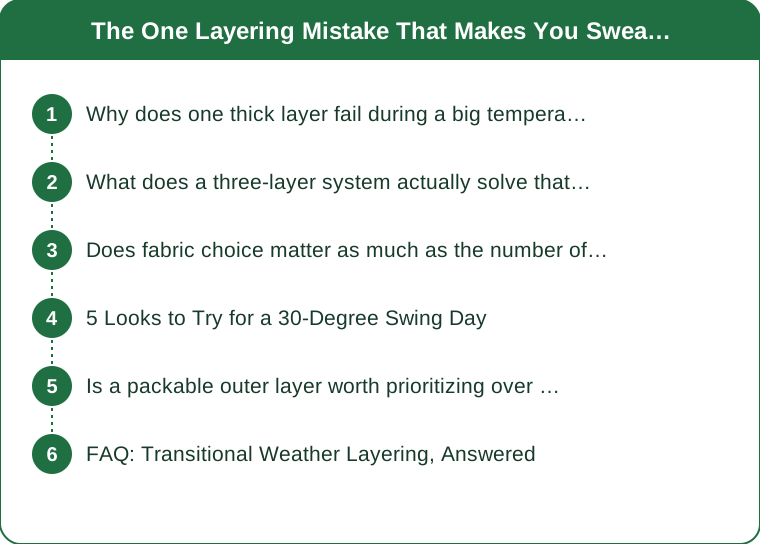
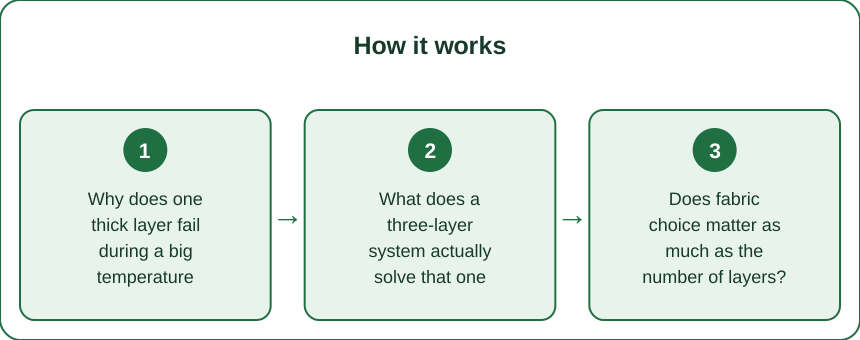
Why does one thick layer fail during a big temperature swing?
A single heavy layer is calibrated for one temperature — usually the coldest point of the day — so it’s necessarily wrong for every other point on the swing. There’s no way to partially remove a single piece, which is the core problem: once it’s too warm, the only option is taking the whole thing off and holding it, or overheating until you can.
What does a three-layer system actually solve that one thick piece doesn’t?
Three thinner, independently removable layers let you subtract heat in increments as temperature rises rather than all at once. A base layer, a light mid layer, and an outer shell each address a different need (moisture, insulation, wind/weather), and each layer can come off separately as the day warms, which matches how temperature actually changes rather than forcing an all-or-nothing choice.
Does fabric choice matter as much as the number of layers?
Yes — a base layer that traps sweat against skin undermines the whole system regardless of how many layers are on top, because damp fabric next to skin cools rapidly once you slow down or the temperature drops again. A moisture-wicking base layer keeps the foundation of the system working even as outer layers change throughout the day.

5 Looks to Try for a 30-Degree Swing Day
- Fitted base layer + light zip mid layer + packable shell — the most adaptable combination for active mornings.
- Tank + open cardigan + scarf — easy to shed piece by piece without breaking an outfit.
- Long sleeve + vest + light jacket — vest adds core warmth without bulking up arm mobility.
- Base layer + button shirt worn open + light jacket — three visually distinct layers that work as one, two, or three pieces.
- Fitted top + oversized cardigan + packable puffer — cardigan handles the mid-range, puffer only comes out for the coldest stretch.
Is a packable outer layer worth prioritizing over a heavier one?
For swing days specifically, yes — a piece that compresses down to bag-size means the removed layer doesn’t become a burden to carry, which is often the real reason people default to one thick layer instead of proper layering: they don’t want to hold a bulky jacket for six hours.
FAQ: Transitional Weather Layering, Answered
How do I know how many layers a specific swing actually needs?
A rough rule: one layer per roughly 15-degree range you’ll experience during the day, so a 30-degree swing generally calls for two to three adjustable layers.
Does layer order matter, or just the total number?
Order matters — moisture-wicking closest to skin, insulation in the middle, wind/weather protection outermost, since reversing this order traps moisture against skin instead of moving it away.
Is it better to start the day slightly cold or slightly warm?
Slightly cold is usually the better call, since movement and rising temperature will warm you within the first 10-15 minutes, while starting warm means sweating before you’ve even adjusted anything.
TL;DR:
- A single thick layer is calibrated for only one point on a temperature swing
- Three thinner, removable layers adapt incrementally as the day warms or cools
- Moisture-wicking base layers matter regardless of how many layers are on top
- Packable outer layers solve the “don’t want to carry a bulky jacket” problem
- Starting the day slightly cold is usually more comfortable than starting warm
Layering for a swing day is about subtraction, not just addition — plan for both ends.
Keep Reading
This article is for general informational and styling purposes only. Fit, sizing, and product availability may vary.