The One Layering Mistake That Makes You Sweat on the Walk, Then Freeze at Your Desk

Quick Answer: The sweat-then-freeze cycle comes from dressing for the coldest moment of your day (the walk outside) instead of building in a layer you can remove entirely once you’re moving or indoors. The fix is one true removable mid-layer, not just ‘more layers.’
You bundle up for the cold morning walk, arrive at work sweaty under three layers, peel down to one, then freeze in an over-air-conditioned office for the rest of the day. This isn’t really a temperature problem — it’s a layering structure problem, and the fix is simpler than buying warmer or cooler clothes.

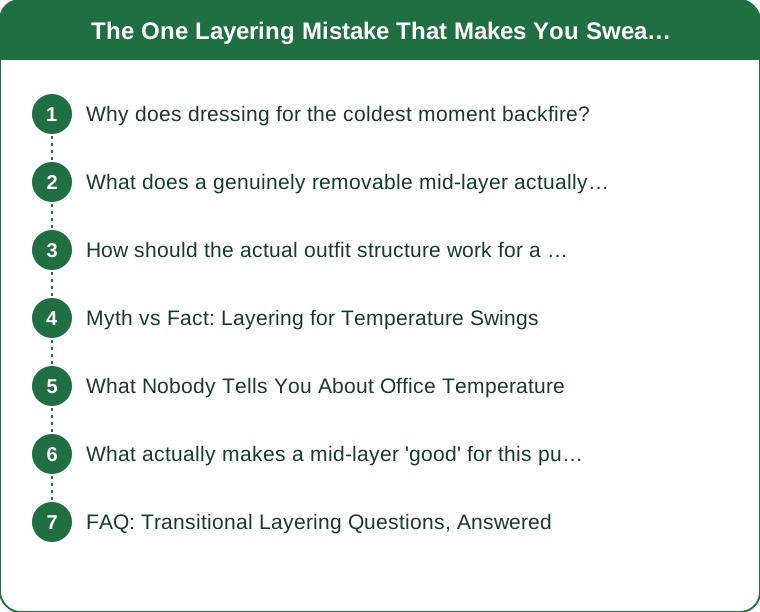
Why does dressing for the coldest moment backfire?
Because the coldest moment of a transitional-weather day (usually the first 10-15 minutes outside) is also the moment you’re moving the most — walking, generating body heat. Dressing at full insulation for that specific window means you’re overdressed for the activity level the moment your body starts producing its own heat, which is almost immediately.
The mismatch isn’t really about outdoor temperature versus indoor temperature — it’s about temperature at rest versus temperature while moving, and most layering advice only accounts for the first one.
What does a genuinely removable mid-layer actually mean?
It means choosing a layer that can come off entirely and pack down small — not just be unzipped. A fitted vest or a packable light jacket that folds into a bag is a true removable layer; a bulky sweater you’re ‘not really wearing anymore but still have on’ because it’s inconvenient to carry is not, and it’s the layer most people end up sweating through and then keeping on anyway out of laziness.
How should the actual outfit structure work for a big temperature swing?
Think in three distinct layers, each with a specific removability role:
- Base layer — worn all day regardless of temperature, moisture-wicking, this is your ‘always on’ layer
- True mid layer — removable and packable, worn only for the coldest window (the walk, waiting for a bus)
- Outer layer — only if actual weather (rain, strong wind) requires it, otherwise skip
The critical piece most people get wrong is treating layer 2 as optional-to-remove instead of built specifically to be removed within the first 20 minutes of the day.

Myth vs Fact: Layering for Temperature Swings
Myth: More layers always means more flexibility. Fact: More layers only add flexibility if each one is genuinely easy to remove and carry — a stack of layers you’re reluctant to take off because they’re bulky just becomes one big overdressed unit.
Myth: You should dress for the average temperature of your day. Fact: You should dress for your lowest-activity, lowest-temperature moment as a base, and add a removable layer specifically for the highest-activity, lowest-temperature moment (often the same window, the commute).
Myth: Natural fibers are always better for temperature swings. Fact: Technical wicking fabrics often handle the sweat-then-cool cycle of a commute better than cotton or wool base layers, which hold moisture against skin during the sweaty phase.
What Nobody Tells You About Office Temperature
Here’s the part people forget: your afternoon office layer needs are almost a separate outfit decision from your morning commute layer needs, and treating them as the same problem is part of what causes the cycle. Many offices run cold from air conditioning even in transitional weather, meaning your ‘too warm for the walk’ mid-layer might actually be exactly right for your desk all afternoon — just not for the 15-minute walk in between.
The fix isn’t fewer layers overall; it’s a mid-layer specifically designed to move between your bag and your body multiple times a day without being annoying to manage.
What actually makes a mid-layer ‘good’ for this purpose?
Look for: packs down to roughly the size of a rolled sweater or smaller, has no delicate fabric that wrinkles badly when balled up in a bag, and doesn’t require re-styling (like a wrap that needs re-tying) every time you put it back on. A simple zip vest or a light packable jacket usually beats a cardigan or scarf for this specific job, purely on convenience of on-off-on again.
FAQ: Transitional Layering Questions, Answered
Should my base layer change with the season or stay the same?
Your base layer’s fabric weight can shift slightly with the season, but its role — worn all day regardless of temperature swings — stays constant; it’s the mid and outer layers that flex.
How do I carry a removed layer without it being annoying all day?
A bag with one dedicated compartment for a rolled layer, rather than stuffing it in with everything else, makes a noticeable difference in whether you actually remove it instead of just tolerating discomfort.
Does this apply to workout commutes too?
Especially — a workout commute has an even bigger swing between generated body heat and post-workout cooldown, making a true removable, packable layer even more valuable than for a regular walk to work.
TL;DR:
- The sweat-then-freeze cycle comes from dressing for the coldest, most active moment of the day and never removing that layer
- Build a mid-layer specifically meant to come off entirely within the first 20 minutes
- Your office’s cold air conditioning may actually want that same layer back later
- Choose a mid-layer that’s genuinely easy to pack and carry, not just technically removable
Tomorrow, wear one true removable mid-layer built to come all the way off on the walk — not just unzip — and see if the sweat-then-freeze cycle actually breaks.
Keep Reading
This article is for general informational and styling purposes only. Fit, sizing, and product availability may vary.