Why Fabric Weight Is the First Thing to Change in Late August, Not the Layer Count

Quick Answer: Late August weather is not cooler summer — it is wider summer: 55-degree mornings and 85-degree afternoons in the same day, which is exactly the range that makes added layers fail. A jacket over a summer outfit is wrong by 10am and a burden by noon; a single heavier fabric in the same silhouette — the ribbed tank instead of the voile one, the ponte pant instead of the linen — is right from 7am to 7pm because density warms the cool hours without trapping the warm ones. Layers are the October tool. August through September belongs to substitution: same outfit formula, weightier cloth, one piece at a time.
Here is the physics of why weight beats layers now, and the swap order that carries a closet to October.

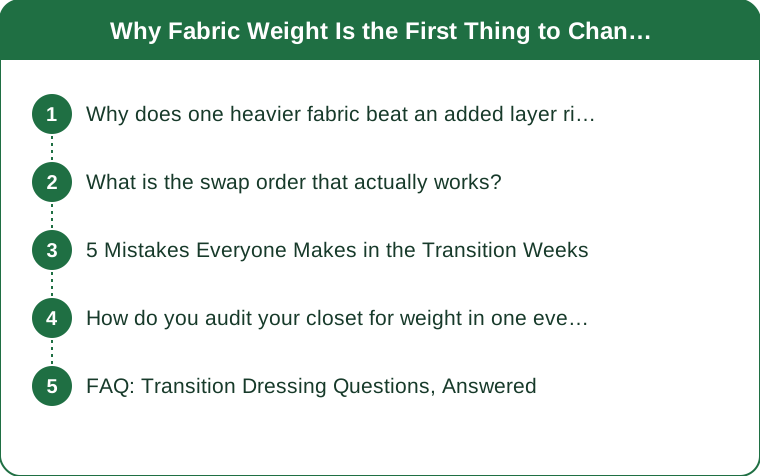
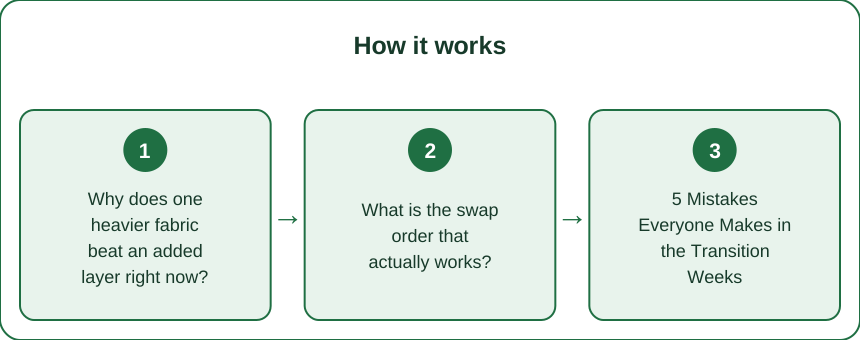
Why does one heavier fabric beat an added layer right now?
Because the two solve different problems, and late August has the substitution-shaped problem.
A layer is a removable air trap: it adds warmth in a big step — jacket on, jacket off — and its whole value is the removability. That is October’s problem: genuinely cold parts of the day, warm interiors, on-off, on-off. But an added layer over summer-weight clothes in August fails on both ends: too warm within an hour of sunrise, then a thing you carry for nine hours. The tell is everywhere in early September — a city full of people with jackets tied around their waists by 10am, having dressed for one hour of their day and paid for it with the other eleven.
Fabric weight is a continuous adjustment rather than a step function. A denser cloth — heavier cotton, a tighter rib, ponte instead of jersey, midweight denim instead of chambray — holds a slightly warmer microclimate against you all day: enough to close the gap on a 58-degree walk to the car, not enough to overheat at 82 in the afternoon, because a single breathable layer still vents fine. Density moves your comfort band up a few degrees and widens it — which is precisely the shape of the late-August gap.
The same-silhouette part matters as much as the weight. Late August is not the moment to change what you wear — only what it is made of. The tank stays a tank, in a ribbed midweight knit instead of gauze. The wide-leg pant stays, in twill instead of linen. The dress stays, in heavier jersey. You keep dressing for the season you are visibly still in — bare arms, summer shapes, sandals if you like — while the cloth quietly does the thermal work. Which is why the swap looks effortless and the jacket-over-sundress combination looks like what it is: two seasons arguing on one body.
Come the first week of real morning cold, layers re-enter and earn their keep. The mistake is only reaching for them six weeks early, when the closet already held the correct answer at the same hanger position.
What is the swap order that actually works?
One piece at a time, in the order the temperature drops reach your body.
First swap: the top. Mornings chill your arms and torso before anything else, so the gauzy tanks and voile blouses rotate back first — replaced by their heavier twins: ribbed tanks, midweight tees, fine-gauge knit shells. Same neckline, same sleeve length, double the cloth density. This single swap fixes the 7am-to-10am problem for most people and costs nothing at noon.
Second swap: the bottom. Linen pants and featherweight skirts hand off to twill, ponte, denim, and heavier jersey. This is also where the activewear half of a closet transitions on its own logic: the ultralight shorts season winds down, and full-length bottoms come back into daily rotation — the first cool-morning dog walks are exactly when flare leggings and thicker bootcut leggings re-earn their drawer space, doing the same job as the ponte pant in the same silhouette-first spirit. Buttery-soft brushed fabrics that felt like too much in July read as exactly right on a 58-degree morning.
Third swap: the dress, as one move. A heavier jersey or midweight cotton dress replaces the sundress wholesale — the single-garment version of the whole strategy, and the reason a good weighty T-shirt dress is the hardest-working piece of the transition.
Fourth, and only when mornings demand it: the first true layer — chosen light. An overshirt, an unlined blazer, a fine-knit cardigan: pieces that read as part of the outfit rather than weather equipment, and that fold into a bag without becoming luggage. This is the bridge to actual fall, arriving weeks after the fabric swaps started.
Feet and accessories trail last. Sandals hold until the mornings genuinely argue; closed shoes, socks, and the scarf family belong to October. Rushing them is how August outfits read costume.
The pace: one category per week from mid-August tracks the actual temperature slide almost perfectly — and because every swap is same-shape, nothing about your style visibly changes. The closet just gets quietly denser.

5 Mistakes Everyone Makes in the Transition Weeks
Dressing for the morning you left in. The 7am chill writes checks the 2pm sun cashes — a full outfit built for 58 degrees is a misery at 84. Dress for the day’s middle, let fabric weight cover the morning edge, and save the layer for the week that stays cold past noon.
Buying fall clothes instead of transition clothes. The September shopping trap: wool sweaters and lined jackets purchased in the first cool week, then unworn for six more. The money weeks are for midweight pieces — the ribbed knits, ponte bottoms, overshirts — that work now and keep working under real layers later.
Storing summer too early. Late August reliably throws one more heat wave; the linen you boxed on the first cool morning comes back out twice. The transition is a rotation, not a hand-off — keep both densities reachable until October settles the argument.
Changing silhouette and weight at once. Long sleeves plus heavier fabric plus closed shoes in one leap lands you visibly overdressed among people still in August clothes. One variable at a time — weight first, shape later — is what keeps the transition invisible.
Ignoring the humidity change. Early September air dries out, and the sweat-wicking logic of deep summer matters less than the slight-warmth logic of density. The technical featherweight top that earned its place in July humidity is exactly the piece whose job just ended — the swap is not only about temperature, but about which problem the fabric is solving.
How do you audit your closet for weight in one evening?
By touch and drape, in about thirty minutes — no purchases required to start.
Sort one category at a time by hand-feel, not looks. Pull every top and split the pile by density: the see-through-when-held-to-light gauzy tier, the midweight tier, the substantial tier. Most summer closets discover the middle tier is thinner than they assumed — a few pieces doing all the transitional work — which is the actual shopping list, written by inventory instead of impulse.
Use the light test and the drape test. Held to a window: fabric you can read shapes through is the summer tier. Draped over a hand: cloth that falls close and heavy holds warmth; cloth that floats does not. Thirty seconds per piece and the closet self-organizes into a temperature system.
Rehang by weight within each category. Light to heavy, left to right. Through the transition weeks, your hand just moves rightward along the rail as the mornings drop — the closet becomes a dial instead of a pile, and the daily decision collapses into which notch is today.
Fill gaps with doubles of your formula pieces. The highest-value transitional buys are heavier versions of what you already reach for: your exact favorite tank, in rib; your wide-leg pant, in twill; your T-shirt dress, in double-weight jersey. Formula stays, cloth changes — which is the whole method in shopping form.
And run the same audit on the activewear drawer. The shorts-to-full-length shift, the light tank to midweight long-sleeve for outdoor mornings — a workout wardrobe transitions on identical logic, one density at a time, and the first chilly-morning walk is noticeably better in high-waisted leggings of real substance than in July’s featherweights with a jacket thrown over.
By the time genuine layer weather arrives in October, everything underneath is already correct — and the layers land on top of a wardrobe that spent six weeks quietly preparing for them.
FAQ: Transition Dressing Questions, Answered
What actual fabrics should I be looking for?
For tops: ribbed cotton and modal knits, heavier slub cotton, fine-gauge sweater knits. For bottoms: ponte, twill, midweight denim, double-weight jersey. The label matters less than the hand — dense, close-falling, opaque-to-window-light is the spec, whatever the fiber.
Is this just buying a whole second wardrobe?
No — it is three to six substitution pieces aimed at your most-worn formulas. One heavier tank, one midweight bottom, one weightier dress covers most weeks, because the swap targets the outfits you repeat, not the closet’s full breadth.
What about the days that are still pure summer?
Wear pure summer — the rotation runs both directions all the way to October. The method is matching cloth density to the day, not marching forward on a calendar. The win is having both densities one reach apart.
When do I know weight has done all it can and layers must start?
When the afternoon high stops rescuing the morning — a day that never crosses about 65 is a layer day no matter the fabric. Around there, the overshirt and cardigan tier activates, and by the first week that pattern holds, you are in fall dressing proper, with a closet that transitioned in order instead of overnight.
TL;DR:
- Late August is wider summer, not early fall: 30-degree daily swings defeat added layers but suit denser fabric, which warms the edges without overheating the middle.
- Swap weight inside the same silhouette — ribbed tank for gauze tank, ponte for linen — one category per week: tops first, bottoms second, dresses third, the first light layer only when mornings insist.
- Avoid the classic traps: dressing for 7am, buying deep-fall pieces in week one, boxing summer before the last heat wave, and changing shape and weight at once.
- Audit by hand-feel and rehang light-to-heavy, so the closet becomes a density dial you turn as September slides.
This week, swap exactly one piece — the heavier twin of your most-worn top — and change nothing else. If the morning walk improves and nobody notices anything different, the method is working precisely as designed.
See It in Motion
Seen here: Bootcut Yoga Pants with Side Pockets — shop it on bubblelime.com
Keep Reading
This article is for general informational and styling purposes only. Fit, sizing, and product availability may vary.