The First Cool Morning of the Season Makes You Overdress All Day

Quick Answer: The first genuinely cool morning feels dramatic because you have spent months acclimatized to summer, so 58°F registers as much colder than the same temperature will feel in November. You dress for that sensation, the afternoon returns to 78°F, and you carry a jacket for eight hours. The fix is dressing for the afternoon high and adding one removable layer for the morning.
You stepped outside, felt actual cold for the first time since May, and thought: finally.
Then it hit 79 by two o’clock and you had a wool cardigan tied around your waist like a regret.

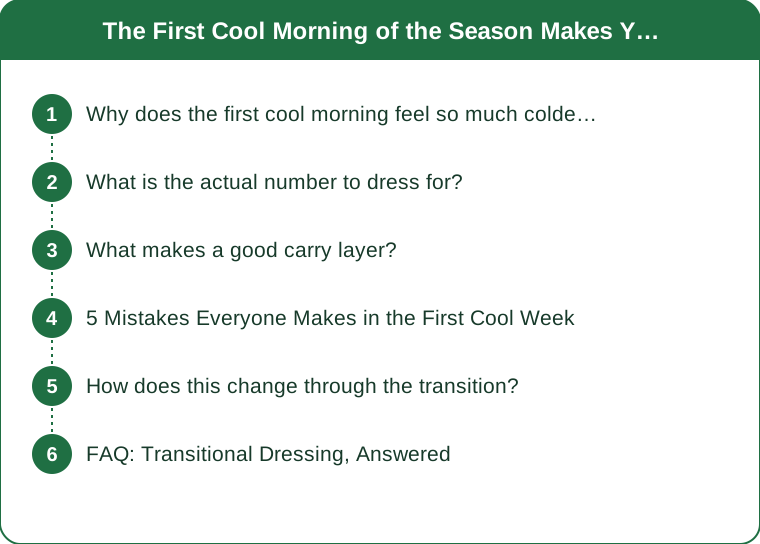
Why does the first cool morning feel so much colder than it is?
Because your perception of temperature is relative to what you have adapted to, not absolute.
After a summer of 80-90°F days, your body has adjusted — more efficient sweating, altered peripheral blood flow, a recalibrated baseline. A 58°F morning lands against that baseline and registers as genuinely cold.
The same 58°F in March, after a winter of 30s, feels mild enough for short sleeves. Identical temperature, opposite experience, and the difference is entirely acclimatization.
This takes roughly one to two weeks to shift. Which means the entire early-fall transition period is spent with a perception that is lagging behind the actual conditions — you feel the mornings more sharply than you will in a month, and you dress accordingly.
Knowing this does not stop you from feeling cold. But it does tell you that the sensation is an unreliable guide to what the whole day requires.
What is the actual number to dress for?
The afternoon high, with one layer for the morning. Not the morning low.
The practical arithmetic: in early fall, most temperate regions see a 15-25°F swing between the dawn low and the mid-afternoon high. You are outside for maybe 30-40 minutes in the coldest part and several hours in the warmest.
So dressing for the low means being correctly dressed for a small fraction of the day and overdressed for the rest.
A working rule:
- Base outfit: what you would wear if the high were the only temperature. Usually still fairly summery in late August and early September.
- One removable layer: a cardigan, an overshirt, a light jacket. Something you can carry without resenting it.
- Nothing else. The tempting second layer is what turns a manageable carry into a burden.
The test for the removable layer: would you be willing to hold it in one hand for four hours? If not, it is the wrong layer for a transitional day.
What makes a good carry layer?
The layer’s carryability matters as much as its warmth, and almost nobody shops for that.
What works:
- A fine-gauge knit cardigan. Folds small, weighs little, ties at the waist without bulk.
- An unlined overshirt or shacket. Structured enough to look intentional, light enough to sling over a bag strap.
- A packable light jacket. Compresses into a bag, which means it disappears completely rather than being carried.
What does not work:
- A chunky knit. Warm for twenty minutes, then a large woolly object you have to hold.
- A structured blazer. Creases badly when carried and looks wrong slung over an arm.
- A trench or anything mid-length. Too long to tie, too big to fold, and it will end up on the back of a chair somewhere you are not.
The best transitional layer is the one you stop noticing once you take it off. That is a narrower category than the outerwear section suggests.

5 Mistakes Everyone Makes in the First Cool Week
1. Switching the wardrobe over on the first cool day. The boxes come out, the summer pieces go away, and then there are ten more warm days. Move a quarter of it and wait two weeks.
2. Wearing boots too early. Feet are the slowest part of the body to change season and the fastest to become uncomfortable. Closed shoes with a light sock outlast boots by weeks.
3. Dressing for the forecast rather than the swing. A forecast that says 78 tells you nothing useful. The range — 58 to 78 — is the number that decides what you wear.
4. Committing to tights. The first tights day usually arrives about ten days after the first tights impulse. Once they are on, there is no removing them at lunchtime.
5. Underestimating buildings. Offices, shops, and transit keep summer air conditioning running well into the transition. The indoor temperature may not follow the outdoor one for weeks, and that alone is often reason enough for the extra layer regardless of the forecast.
How does this change through the transition?
It resolves in roughly three phases, and knowing which one you are in makes the daily decision much easier.
Phase 1 — the first two weeks (late August into September in most of the US). Big swings, warm afternoons, cool mornings. Summer base plus one removable layer. Your perception is running cold; trust the forecast over the feeling.
Phase 2 — genuine transition (mid-September into October). Highs drop into the 60s and 70s. The removable layer becomes a worn layer for more of the day. This is when a real jacket earns its place and when closed shoes stop being optional.
Phase 3 — settled fall. The swing narrows, mornings and afternoons converge, and dressing gets simple again. You are now acclimatized, and that same 58°F morning feels ordinary.
The frustrating middle is phase 1, and it is short. Two weeks of carrying a cardigan is the actual cost of the season changing, and no wardrobe strategy eliminates it entirely.
FAQ: Transitional Dressing, Answered
Should I buy transitional pieces or just layer summer and winter clothes?
Layering what you have works for most of it, with one exception worth buying for: a genuinely good lightweight carry layer. Most wardrobes have plenty of summer and plenty of winter and nothing that solves a 20-degree swing. One well-chosen cardigan or overshirt does more transitional work than a rack of new pieces.
How do I stop feeling cold in the morning without overdressing?
Cover the extremities rather than the core. A scarf and a long sleeve do more for morning comfort than a heavier top, and both are easy to remove. Warm hands and a covered neck change perceived temperature disproportionately, which is why they are the first things to reach for and the easiest to shed.
When should I actually put the summer clothes away?
When you have gone two full weeks without reaching for any of them. That is usually several weeks after the first cool morning tempts you to do it. Sleeveless tops in particular keep working as base layers well into fall, so those should be the last to go rather than the first.
TL;DR:
- The first cool morning feels colder than it is because you are still acclimatized to summer — that lag lasts one to two weeks.
- Dress for the afternoon high plus one removable layer, not for the morning low.
- A good carry layer is one you would happily hold for four hours: fine-gauge knit, unlined overshirt, packable jacket.
- Do not switch the wardrobe over, put on boots, or commit to tights on the strength of one cold morning.
- Indoor air conditioning often justifies the layer even when the forecast does not.
The reframe that makes the next fortnight easier: the cold morning is not the season arriving, it is a preview. Enjoy it, wear the cardigan for an hour, and keep the rest of the outfit set to August — because the afternoon is still August, whatever the sunrise suggested.
Keep Reading
This article is for general informational and styling purposes only. Fit, sizing, and product availability may vary.