Why the Commute Is the Part of Transitional Dressing That Breaks

Quick Answer: A commute takes you through three or four distinct environments in twenty minutes — a cold street, a heated bus or train, a walk that raises your body temperature, and a warm building — while carrying a bag. Dress for the environment you are in longest, not the one that feels worst, and build the outfit so one layer removes in under five seconds without putting your bag down. That last constraint is the one people never design for and it decides everything.
At home you were comfortable.
At your desk you are comfortable.
On the platform you were freezing and on the train you were sweating.

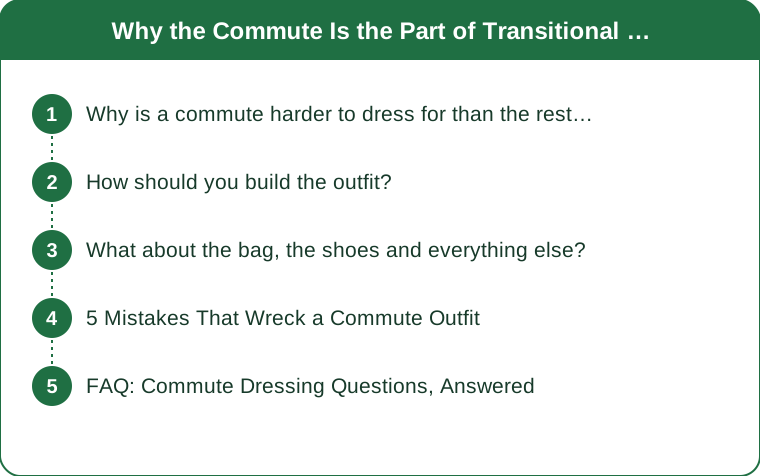
Why is a commute harder to dress for than the rest of the day?
Because of the sequence, not the temperature.
You pass through three or four environments in twenty minutes. Cold outdoors, an overheated carriage, a brisk walk, a heated building. Nothing else in your day changes conditions that fast.
You are generating heat at the same time. Walking briskly with a bag raises your body temperature well above resting within a few minutes, which means the temperature you dressed for is not the temperature you experience.
Public transport is aggressively heated. Trains and buses in autumn are frequently warmer than the buildings at either end, and they are the part of the journey you cannot leave.
Your hands are full. You are carrying a bag, a coffee, a phone. Any layer that requires two free hands and thirty seconds is a layer you will not remove.
Waiting and moving are opposite problems. Five minutes standing still on a cold platform demands more insulation than fifteen minutes walking. Most commutes contain both.
And you cannot change once you arrive. Whatever you wore for the commute is what you wear all day, unless you plan for it.
How should you build the outfit?
Around the constraint of removability, not around warmth.
Make the outermost layer the only thing you remove. One action, carried over an arm, no rearranging.
Choose a mid layer you can wear all day. A cardigan, a light knit, an overshirt — something that is part of the outfit rather than obviously outerwear. This is the piece that makes the whole system work.
Use accessories as the fine adjustment. A scarf, a hat and gloves add and remove in seconds and pack into a bag. They provide a surprising amount of the warmth you need on a cold platform and none of it on a warm train.
Avoid the single thick coat. It has two settings and one of them is wrong in every environment you pass through.
Keep the base layer breathable. Whatever is against your skin will get warm during the walking sections. Natural fibres or technical knits handle that; a synthetic base under two layers does not.
Dress for standing still, remove for moving. Then plan to arrive slightly cool rather than slightly warm, because a warm building will finish the job.

What about the bag, the shoes and everything else?
The parts that quietly cause the most discomfort.
A bag creates a hot spot. A backpack or a shoulder strap traps heat against your back or shoulder, so you overheat in one place while the rest of you is fine. Consider it a layer, because it functions as one.
Shoes are the hardest single item. Wet mornings and warm afternoons want different shoes and you only get one pair. Water-resistant with a breathable upper is the practical compromise; keeping a second pair at work is the actual solution for anyone who can.
Sock weight matters more than shoe choice. Changing sock thickness alters foot temperature more than most people expect, and it is free.
Hands go cold first and warm up last. Thin gloves that fit in a pocket solve more commute discomfort per gram than any other item.
Neck coverage is the highest-leverage adjustment. A scarf changes perceived warmth substantially, and removes in one motion.
Seasonal note: the hardest week is the one where mornings are genuinely cold and afternoons are still mild — a 10 to 12°C swing between the commute in and the commute out. Dressing for the morning means being wrong at 5pm. This is the specific week for which the light removable mid layer plus accessories approach exists.
5 Mistakes That Wreck a Commute Outfit
Dressing for the platform. It is the coldest three minutes and the least representative part of the journey. Use a scarf and gloves for that, not a heavier coat.
Choosing a layer you cannot remove one-handed. If it needs both hands and a place to put your bag down, you will suffer instead.
Wearing the mid layer as the outer layer. Then there is nothing to take off, and you are stuck in whatever you have.
Ignoring the bag as a heat source. Backpacks in particular make a perfectly judged outfit too warm from one specific point.
Forgetting the journey home is a different journey. It is warmer, you are more tired, and you often carry more. Plan for two conditions, not one.
And the one nobody admits: wearing the outfit that looks best for the office and treating the commute as something to endure. The commute is 40 minutes of your day and it sets your comfort baseline for the first hour at your desk.
FAQ: Commute Dressing Questions, Answered
How many layers do I actually need?
Three: a breathable base, a mid layer you can wear all day, and one removable outer layer. Accessories on top for fine adjustment.
Should I dress for outside or inside?
For inside, plus accessories for outside. You spend far longer indoors and you cannot change once you arrive.
What is the single most useful item?
A scarf. Substantial warmth, removes in one motion, packs to nothing.
How do I stop arriving sweaty?
Leave slightly cool, walk at a steady pace rather than rushing, and remove a layer before you start walking, not after you feel warm.
What about shoes on wet mornings?
Water-resistant with a breathable upper. Keeping a second pair at work is the only complete answer.
Why am I always too warm on the train?
Because carriages are heated well above building temperature. Plan a layer specifically to remove when you board.
How do I handle a big morning-to-evening temperature swing?
A light mid layer plus accessories. Both come off for the walk home, and neither requires a different coat.
TL;DR:
- Commutes fail because they pass through three or four environments in twenty minutes while you generate heat and carry a bag.
- Build around one layer you can remove one-handed in five seconds.
- Dress for indoors, and use scarf, hat and gloves for the cold platform.
- The bag is a layer — it traps heat in one spot and ruins otherwise correct outfits.
- Plan the journey home separately; it is warmer and you are carrying more.
Tomorrow, test whether you can remove your outer layer without putting your bag down. If you cannot, that is the piece to change.
Keep Reading
This article is for general informational and styling purposes only. Fit, sizing, and product availability may vary.