Why the Hardest Week to Dress for Is the One With a 20-Degree Daily Swing

Quick Answer: A 20-degree daily swing exceeds what any single-layer outfit can handle, because clothing works within roughly a 10-degree comfort band. The solution is a two-piece system where one removable layer covers the entire swing — and choosing that layer for packability rather than for warmth, since you’ll be carrying it more than wearing it.
You leave the house cold and arrive somewhere sweating. Or you dress for the afternoon and spend the morning miserable. It’s not that you’re bad at this — late August and September genuinely produce swings that no single outfit covers.
Why can’t one outfit cover a 20-degree range?
Because a garment’s insulating value is essentially fixed, and comfort tolerance is narrower than people assume.
Most clothing keeps you comfortable within about a 10°F window. Above it you overheat; below it you’re cold. That’s a property of the insulation, not of your willingness to tolerate it.
A 20-degree swing is therefore two comfort windows wide. Any single outfit will be correct for one end and wrong for the other — and typically wrong for four or five hours of the day.
The compounding factor is that the temperature isn’t the only thing changing. Morning brings dew and higher humidity, which makes 58°F feel colder than the number suggests. Afternoon sun adds radiant heat beyond the air temperature. The felt swing is often larger than the forecast swing.
What this means practically
You need a removable component that covers roughly 15 degrees on its own. That’s a bigger ask than most light jackets meet, and it’s why people end up carrying something that’s neither warm enough at 7am nor packable enough at 2pm.
What should the removable layer actually be?
The properties that matter are different from what people shop for.
Packability outranks warmth. On a swing day, you’ll wear the layer for maybe three hours and carry it for six. A layer that’s genuinely warm but bulky gets left at home after two frustrating days — and a layer at home covers nothing.
It needs to look intentional off the body. This sounds superficial and is actually the deciding factor. A jacket that looks fine tied at the waist or folded over a bag gets carried. One that doesn’t gets abandoned in a car or an office and isn’t there when the temperature drops again at 6pm.
Choose one that layers over a range of tops, not one that only works with a specific outfit. Its job is to be the constant in a rotating system.
Three that work well
A lightweight quilted or shirt jacket — real insulation, folds small, reads as deliberate when carried.
A large scarf or wrap — surprisingly effective, since neck coverage handles a large share of perceived warmth, and it packs to nothing.
A knit cardigan in a fine gauge — less warm than the others but the easiest to wear indoors, which matters when the office is 68°F all day regardless of outside.
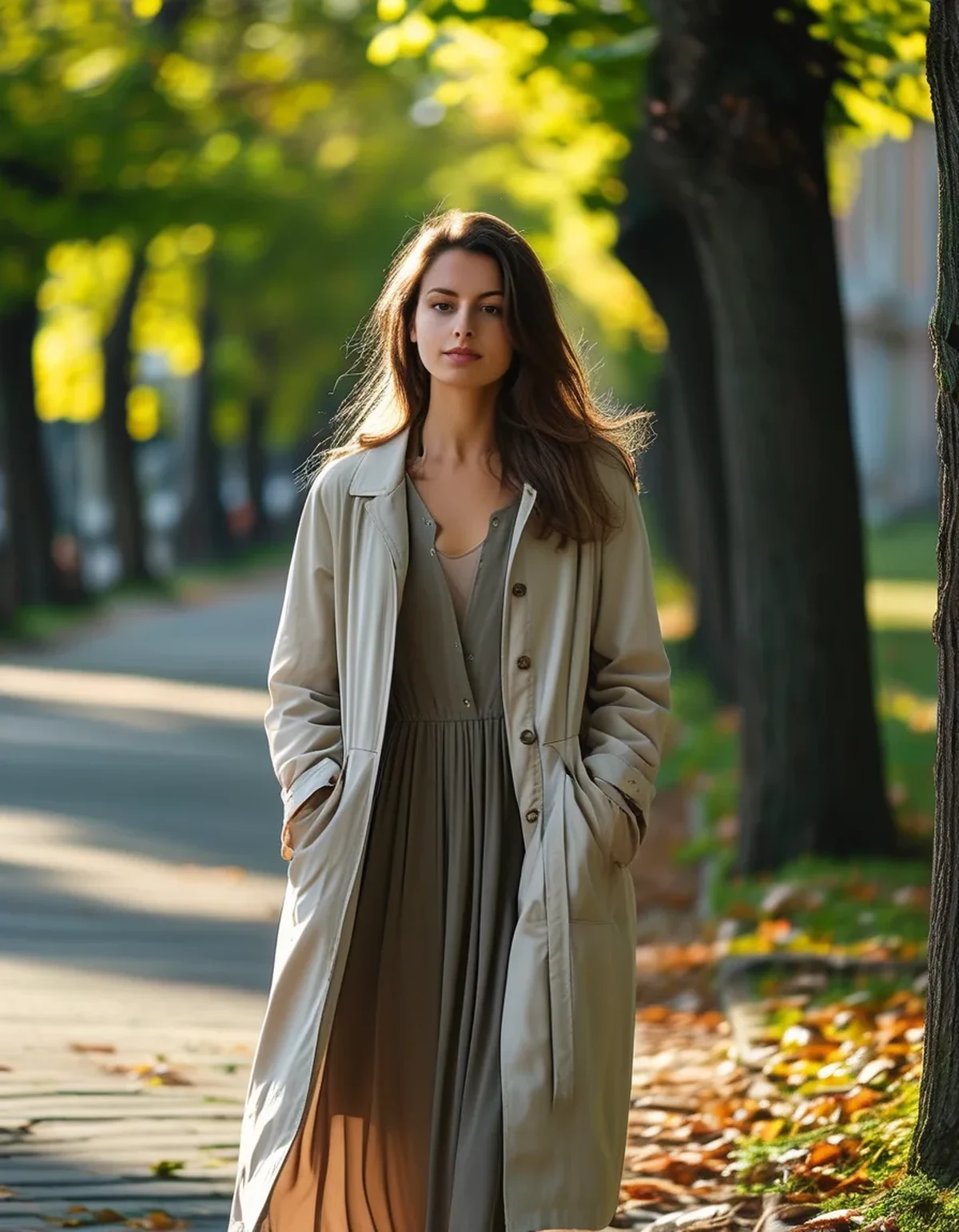
How should the base outfit change?
Toward breathability, and away from anything that only works at one temperature.
Choose fabrics that handle both ends. Cotton, linen blends, and merino perform across a wider range than synthetics, which tend to be optimized for one condition. Merino in particular handles a swing better than almost anything, which is why it dominates travel wardrobes.
Avoid the mid-weight trap. The instinct is to split the difference — a medium-weight top that’s supposedly right for both ends. In practice it’s slightly wrong at both, and it removes the option of adjusting. A light base plus a real layer beats a medium base with nothing.
Sleeves matter more than you’d expect. A three-quarter or push-up sleeve gives you a small adjustment without changing anything, and it covers a surprising amount of the middle range.
Consider the bottom half separately. Legs tolerate a wider range than the torso, which means a single bottom usually works for the whole day. Focus the layering system on the top and don’t overthink the rest.
5 Mistakes People Make in Transition Weather
1. Dressing for the forecast high. The high usually lasts two or three hours. The rest of the day is closer to the average, and mornings are typically the coldest part of your actual routine.
2. Choosing a layer that’s too warm to carry comfortably. A heavy jacket is either worn or a burden. There’s no middle state, and by mid-morning it’s a burden.
3. Ignoring the indoor variable. Buildings often over-air-condition through September while it’s still warm outside. Your indoor hours may be the coldest part of the day, which inverts the whole calculation.
4. Waiting for a clean seasonal switch. People hold out for the week where it just becomes fall. In most regions that week doesn’t exist — there are six weeks of swings and then it’s cold. Building the swing system is the actual solution.
5. Forgetting the evening. A day that hits 80°F at 2pm can be back to 58°F by 8pm. Evening plans on a swing day need the layer more than the morning did, and it’s the moment people most often find they left it somewhere.
FAQ: Transition Dressing Questions, Answered
How do I know if a day is a swing day?
Check the difference between the forecast high and low. Over 15°F means you need the system; over 20°F means you’ll definitely be uncomfortable without it.
Is a vest a good transition layer?
Very good, actually. Core warmth without arm bulk, and it packs smaller than a jacket. Underrated for exactly this situation.
What about rain in transition season?
A packable water-resistant layer solves both problems with one garment, which is why the light shell is the most common transition piece.
Should I keep summer clothes accessible into October?
Yes — in most of the US, genuinely warm afternoons continue well into October. Packing summer away in September is usually premature by a month.
What’s the single best purchase for this season?
A fine-gauge knit or lightweight quilted layer that folds into a bag. The one you’ll actually carry beats the one that’s warmer.
TL;DR:
- Clothing works within roughly a 10°F comfort band; a 20°F swing is two bands wide
- Pick the removable layer for packability and how it looks carried, not for maximum warmth
- Use a light base plus a real layer, not a medium-weight compromise at both ends
- Indoor air conditioning can make your building the coldest part of a warm day
- Evenings drop fast — the layer you needed at 7am is needed again at 8pm
There’s no outfit that covers a 20-degree day. There’s a system that does, and it comes down to one layer chosen for whether you’ll actually carry it.
Keep Reading
This article is for general informational and styling purposes only. Fit, sizing, and product availability may vary.