Why Your Bag Is the Real Transitional Layering Tool

Quick Answer: Transitional dressing fails because a single outfit cannot cover a twenty degree daily swing, and layering only works if the layers can come off and go somewhere. That somewhere is your bag. Choosing a bag with real capacity, and deciding what lives in it for the season, solves the problem that no amount of clever outfit planning does. Two items — one warm layer and one weather layer — cover almost every early autumn day.
The outfit is half the answer. The bag is the other half.
Why does layering alone keep failing?
Because the removed layer has to go somewhere, and if that somewhere is your arm, the system breaks.
The standard advice for transitional weather is to layer. That is correct and incomplete. A layering plan is only usable if you can shed and re-add layers throughout the day, which requires storage.
Without it, three things happen.
You keep the layer on past the point of comfort, because carrying it is worse than being slightly too warm. So you spend the middle of the day overheated in a cardigan you took off mentally hours ago.
Or you tie it around your waist, which works for some outfits and is a visual commitment.
Or you leave the layer at home entirely, having learned from previous days that you would just be carrying it. Then the temperature drops at four and you are cold.
The third one is the most common. People do not fail at transitional dressing by choosing wrong in the morning; they fail by having no way to carry the alternative.
Once you frame it that way, the solution is obvious and slightly unglamorous. The single most effective transitional wardrobe purchase is usually a bag.
What should actually live in the bag?
Two items, plus two small ones. More than that and you stop carrying it.
One warm layer that packs small. A fine-gauge knit, a light cashmere, a packable down vest. The requirement is that it compresses to something you will genuinely carry, not that it is the warmest thing you own. A bulky sweater that fills the entire bag will be left at home within a week.
One weather layer. A packable rain shell or a wind layer. Early autumn brings unpredictable rain, and being caught in it changes the day. A shell that packs into a small pouch weighs almost nothing.
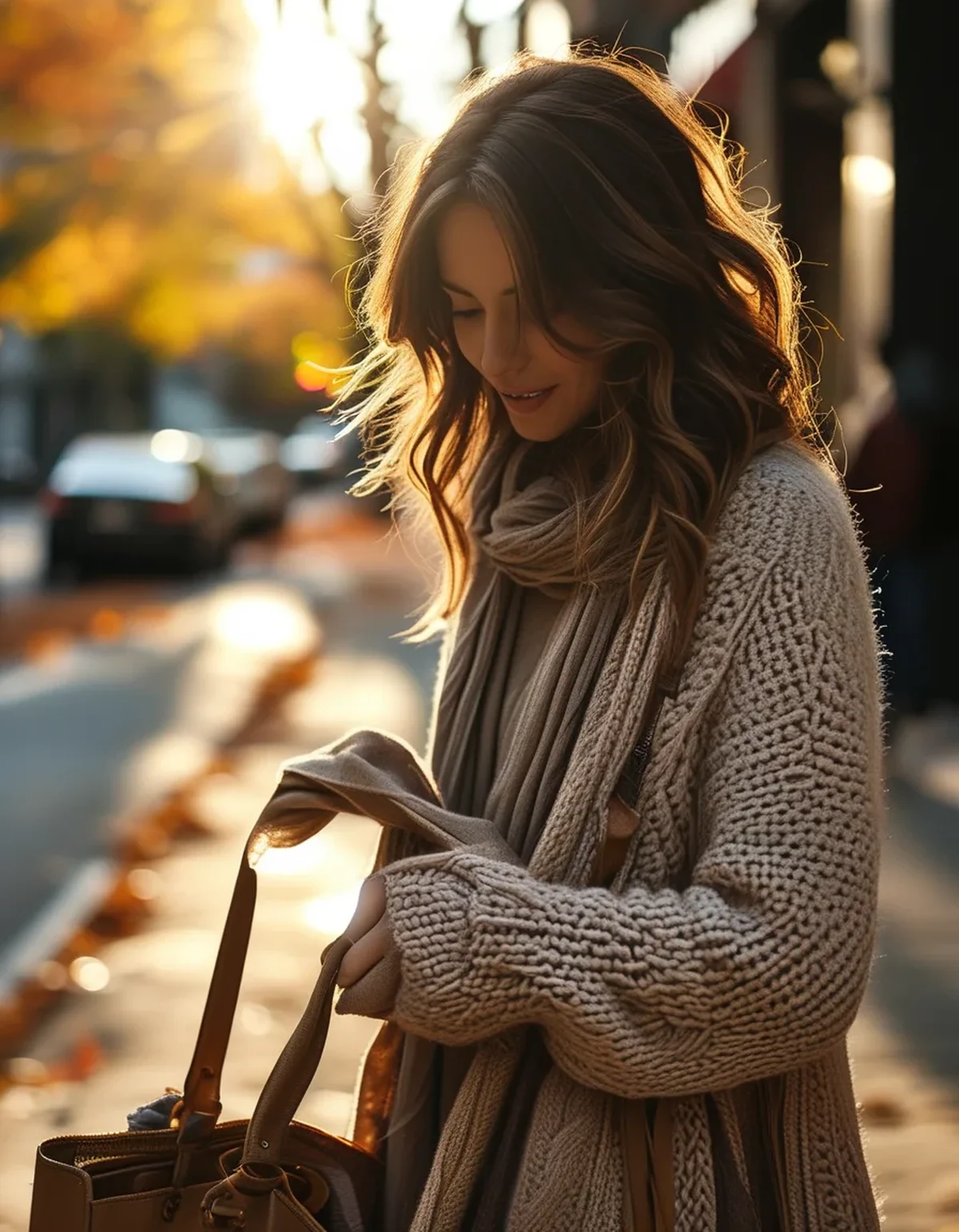
A scarf. The highest warmth-to-volume ratio of any garment. It also changes an outfit visually, which means it works as both a functional and a styling layer.
A spare pair of socks, if you walk to work. Not for everyone, and transformative for anyone who has arrived somewhere with wet feet.
That is it. Together those come to less than most people carry in daily miscellany.
What not to carry: a second pair of shoes, unless you have a specific reason. Weight and bulk are what kill the habit, and shoes are the heaviest thing anyone is tempted to add.
One organizing tip that makes the difference between a system and a mess: keep the warm layer and the shell in a single pouch or packing cube. They stay together, they stay compressed, and moving them between bags takes two seconds rather than a repack.
5 Mistakes Everyone Makes With the Transitional Bag
Choosing a bag too small to hold a sweater. The most common failure. A bag that fits a laptop and a wallet does not fit a layer, which means the whole system does not run. Capacity is the first requirement, not the last.
Carrying so much that you stop carrying it. The opposite failure. Two garments and two small items. Every addition beyond that reduces the chance you take the bag at all.
Picking layers by warmth rather than by pack size. The warmest cardigan you own is not the right one if it takes up the whole bag. A thinner layer you actually have with you beats a warmer one at home.
Forgetting to restock it. You use the shell on a wet Tuesday, hang it up at home, and it is not there on Thursday. A weekly reset — Sunday evening, check the bag — keeps the system running.
Buying a bag that only works with some outfits. If the bag does not go with what you wear, it stays home on exactly the days you would need it. This is the argument for a neutral, plain bag over a statement one for daily transitional use.
How does this change as autumn progresses?
The contents rotate, and the timing is fairly predictable.
Now, in the late-August to mid-September window, the swing is at its widest — genuinely cool mornings and genuinely warm afternoons. This is peak bag season. The morning layer comes off by ten and goes back on by five, and both transitions happen away from home.
By late September and October, the baseline drops enough that the morning layer often stays on. The bag shifts from carrying a warm layer to carrying a weather layer, because autumn rain becomes the dominant variable.
By November, the outfit itself carries the warmth and the bag is back to being a bag. The transitional problem resolves because the days stop swinging — cold in the morning and cold in the afternoon is much easier to dress for than a twenty degree spread.
Which gives you a useful planning frame: this is a roughly six to eight week problem, not a permanent one. It is worth setting up a system for, and it is not worth an enormous investment.
The reverse happens in spring, and it catches people out again because they have forgotten. Whatever pouch you assemble now, keep it together over the winter. In March you will want exactly the same two items, and having them already packed removes the several-week lag where you have not yet remembered how this works.
One last point on the outfit side, since the bag is only half the system: build the day’s outfit so that removing one layer still looks intentional. The most common transitional outfit failure is a look that only works with the cardigan, so removing it means looking underdressed for the rest of the day. Two layers that each work alone beats three that only work together.
FAQ: Transitional Bag Questions, Answered
What kind of bag works best?
Something with genuine capacity and a shape that does not look empty when it is. A structured tote or a soft backpack both work. The specific style matters less than whether it holds a folded knit without looking stuffed.
Is a tote or a backpack better?
Backpack if you walk or cycle any distance, since the weight distribution matters. Tote if your commute is short and you are in and out of it frequently. Both work; the deciding factor is usually how far you carry it.
What if my workplace does not suit a big bag?
A smaller bag with a packable shell and a scarf still covers most of the benefit. The warm layer is the bulky one — if you can only carry one thing, in early autumn make it the shell, since being wet is worse than being cool.
How do I stop overpacking?
Limit yourself to one pouch. If it does not fit in the pouch, it does not come. Physical constraints work better than intentions.
TL;DR:
- Layering only works if removed layers have somewhere to go, and the missing piece is usually storage rather than clothing.
- Carry two garments — one packable warm layer, one packable shell — plus a scarf, and keep them together in one pouch.
- Choose layers by how small they pack, not by how warm they are; a bulky sweater gets left at home.
- The wide-swing window is about six to eight weeks. Keep the pouch assembled over winter and you will be ready in March.
Pack the pouch tonight. Tomorrow morning’s decision gets much easier when the alternative is already in the bag.
Keep Reading
This article is for general informational and styling purposes only. Fit, sizing, and product availability may vary.