Why Your Morning Outfit Is Wrong by 3pm in Early Fall

Quick Answer: Early fall days routinely swing 20 to 25°F between 7am and 3pm, and most people build the outfit around the coldest hour. That guarantees the other seven hours are wrong. The fix is to dress for the afternoon as your base outfit and treat the morning as a removable problem — one warm outer layer, one accessory, both of which can disappear into a bag.
You leave the house comfortable, and by mid-afternoon you’re carrying a sweater, pushing sleeves up, and wondering how you got this so wrong when you checked the forecast twice.
Why does the same forecast produce two different days?
Because early autumn has the largest diurnal temperature range of the year in most temperate regions — commonly 20 to 25°F between overnight low and afternoon high.
The reason is atmospheric. Air is drier than in summer, so less water vapor is holding overnight heat, and nights are getting long enough for real radiative cooling. Meanwhile the sun is still strong enough at midday to heat things fast.
So the forecast high of 72°F and the forecast low of 48°F are both accurate. You just experience roughly two hours of each and six hours in between.
The practical consequence: the outfit that’s correct at 8am is objectively wrong at 2pm. No fabric solves that. Only a change of configuration does.
What’s wrong with dressing for the cold morning?
It optimizes for the shortest and least social part of your day.
Most people are outside for 15 to 30 minutes in the morning — a walk to transit, a school run, a dash to the car. They’re then indoors or in mild afternoon air for eight hours.
Building a whole outfit around that half hour means you spend the rest of the day slightly too warm, which affects more than comfort. Being marginally overheated raises perceived effort, makes you drink less water than you should, and turns your bag into a coat rack.
The reverse approach — base outfit for the afternoon, one removable layer for the morning — is correct for the majority of your hours and only mildly wrong for a short window you can walk briskly through.
What does dressing for the afternoon actually look like?
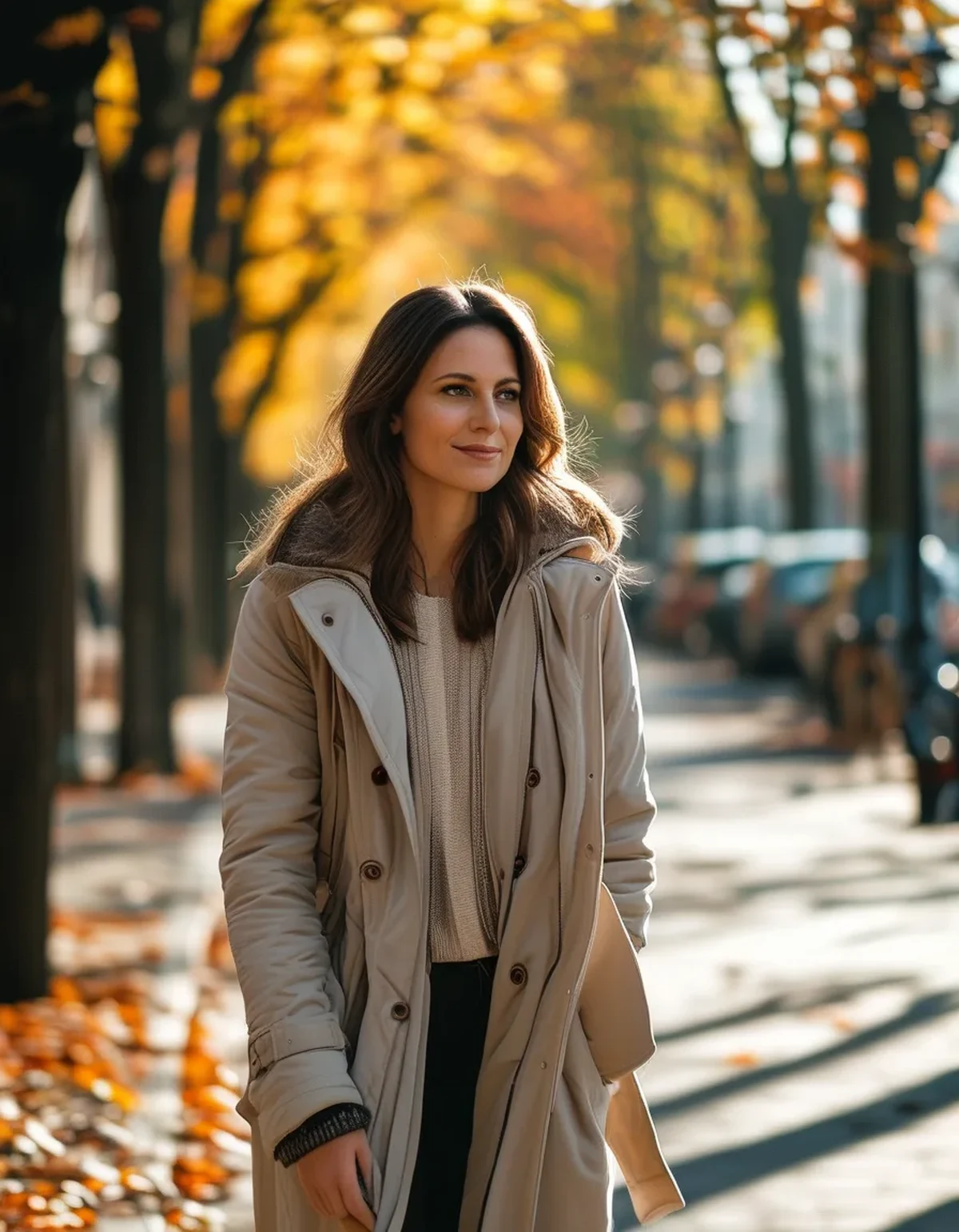
Three layers, but not the three most people reach for.
Base: whatever you’d genuinely wear at 70°F. A tee, a light knit, a short-sleeved dress. This is the outfit, not an undergarment.
Mid: something that reads as intentional on its own — a shirt jacket, a cardigan, an unstructured blazer. This comes off at 11am and goes over the back of a chair, not into a bag.
Outer: only if the morning is under 50°F, and it should compress. A packable puffer or a lightweight trench that folds to nothing.
The rule that makes it work: every layer above the base has to look deliberate when it’s on and disappear when it’s off. A bulky fleece fails the second test, which is why it always ends up tied around a waist.

Myth vs Fact: Transitional Dressing
Myth: More layers means more flexibility. Fact: Four thin layers you can’t realistically remove in public is less flexible than two you can. Flexibility is about removability, not count.
Myth: You should dress for the average of the day. Fact: The average temperature is the one you’ll experience least. Dress for the mode — the temperature you’ll spend the most hours in.
Myth: Sunny means warm. Fact: In October, direct sun can feel 10 to 15°F warmer than shade at the same air temperature. A sunny-side walk and a shady-side walk are different days.
Myth: Boots signal fall, so it’s time for boots. Fact: Footwear traps far more heat than any upper layer and can’t come off. Closed shoes with thin socks beat boots by a wide margin through most of September and half of October.
What makes the morning half hour survivable?
Accessories, because they’re the highest warmth-to-bulk ratio you own and they fit in a pocket.
A light scarf covers the neck, where a lot of perceived cold registers, and folds down to nothing. A thin pair of gloves does the same for hands, which are where cold is felt first and most.
These two items are worth more than an entire extra clothing layer for a 30-minute exposure, and neither one leaves you carrying anything visible by 10am.
One more piece: walk faster. Body heat production rises sharply with pace, and a brisk 15-minute walk generates enough to make a 48°F morning genuinely comfortable in a mid layer alone. Standing still at a bus stop is the actual cold problem, not walking.
Does this change week to week?
It does, and the changeover is faster than most people plan for. In most temperate regions the swing narrows through October as afternoon highs come down, and by early November you’re back to a single-configuration day.
A useful checkpoint: once the afternoon high stops exceeding the morning low by more than 15°F, dress for the whole day again and retire the removable-layer approach until spring.
Until then, the practical habit is to check two numbers rather than one — not the high, but the 8am temperature and the 3pm temperature. Most weather apps show hourly; almost nobody looks.
That single 20-second check is the entire skill. Everything else follows from knowing which two temperatures you’re dressing between.
FAQ: Early Fall Outfit Questions, Answered
What if I can’t carry a bag?
Then the mid layer has to be one you’d happily wear tied or draped — a soft cardigan or a shirt jacket. Skip the outer layer entirely and add the scarf-and-gloves combination instead, both of which fit in pockets.
How do I handle a cold office in a warm-afternoon outfit?
The mid layer solves both problems, which is why it should live on your chair rather than in your bag. Indoor air conditioning is often the coldest environment of an early fall day.
Is there one fabric that handles the whole range?
Merino comes closest, because it manages moisture well across a wide temperature band and doesn’t hold odor. But no fiber makes a 24°F swing disappear — it just makes each end of it more tolerable.
TL;DR:
- Early fall swings 20 to 25°F daily; the morning outfit is wrong for most of your day.
- Build the base outfit for the afternoon, add one removable mid layer for the morning.
- Every layer above the base must look intentional on and vanish when off.
- Scarf and thin gloves beat an extra clothing layer for short exposures.
- Check the 8am and 3pm hourly numbers, not the daily high.
The reason this season feels so hard to dress for is that everyone treats it as a colder version of summer or a milder version of winter. It’s neither — it’s the one time of year when a single outfit genuinely cannot be right all day, and the sooner you stop trying to find one, the sooner the mornings stop costing you the afternoons.
Keep Reading
This article is for general informational and styling purposes only. Fit, sizing, and product availability may vary.