Why Your Transitional Outfit Fails at the Doorway Not Outdoors

Quick Answer: Transitional dressing fails because people optimise for the outdoor temperature, when the actual challenge is the repeated switching between cool outdoors and heated indoors. A single well-chosen weight is wrong in one of the two environments by definition. The solution is layers you can change in seconds without a bathroom - which rules out most of what people actually wear - plus accepting that you will feel slightly cold outside if you want to be comfortable inside.
Here is how to build for the switching rather than the weather.
Why is the switching the real problem?
Because you do it many times a day and each transition is abrupt.
The temperature difference is large. A cool autumn morning outdoors and a heated shop or office can differ substantially, and you move between them within seconds rather than gradually.
Your body cannot adapt that fast. Thermoregulation works over minutes, so you spend the first several minutes in each environment being wrong - too warm indoors, too cold outdoors - regardless of what you are wearing.
And overheating indoors has a delayed cost. If you get warm enough to sweat lightly in a shop, that dampness then cools you rapidly when you step outside - which is why people feel colder after being indoors than they did before.
Most clothing is not designed for fast switching. A jumper requires removing whatever is over it and finding somewhere to put it. A coat you can unbutton in three seconds is a fundamentally different tool from a jumper that requires undressing.
Which reframes the whole problem. The question is not what is warm enough for 12 degrees. It is what can I change in five seconds, repeatedly, without needing a bag or a bathroom - and that is a much more restrictive requirement than warmth.
What actually works for fast switching?
Openable, removable, and carryable - in that priority order.
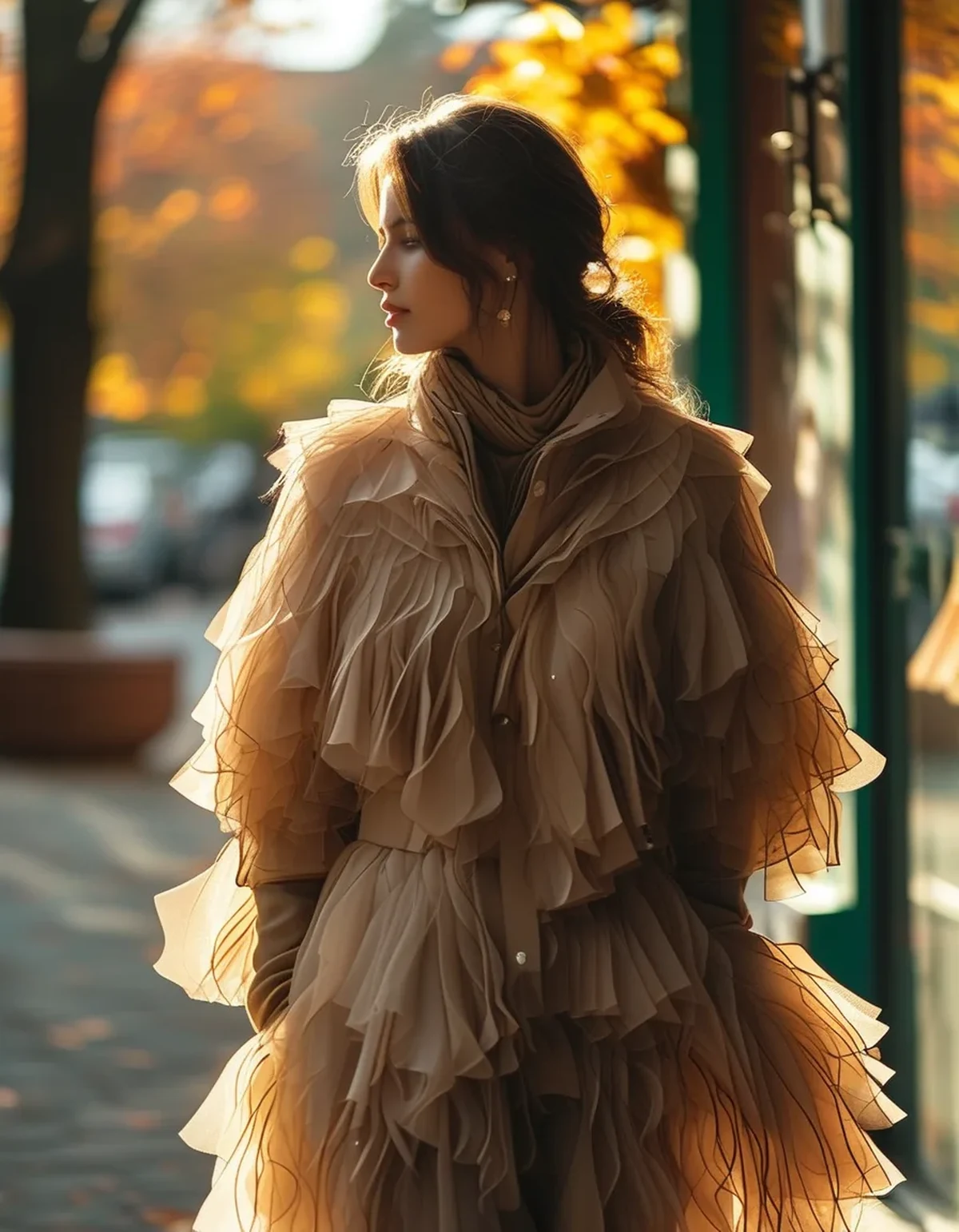
Openable beats removable. A jacket, cardigan, or shirt you can unfasten adjusts in two seconds and requires nowhere to put it. This is the single most useful property in transitional clothing and it is why the open cardigan and the unbuttoned overshirt are perennial autumn staples.
Removable beats fixed. A layer you can take off is better than a warm layer you cannot, but only if you have somewhere to put it - which means either a bag or a layer that ties or drapes.
Accessories do the fastest adjusting of all. A scarf, gloves, or a hat can be added and removed in seconds, take almost no space, and adjust a meaningful amount of your total warmth. A scarf alone is worth roughly a layer.
Choose breathable over warm for the base. The base layer determines whether you get damp when you overheat indoors, and dampness is what makes the next outdoor stretch unpleasant. Natural fibres or technical fabrics both work; cotton jersey holds moisture and is the common culprit.
And avoid a single heavy layer. One thick jumper is warm outside and unbearable inside with no intermediate setting. Two thinner layers give you three configurations instead of two.
The practical structure: a breathable base, a light mid layer you can remove, an openable outer, and one accessory. Four items with a range far wider than any two-item outfit.

How does this change through the transition weeks?
The pattern shifts predictably, and knowing it prevents daily guessing.
Early transition - now - is defined by wide daily swings. Cool mornings, genuinely warm afternoons, cool evenings. The morning outfit is wrong by 2pm and right again by 7pm, which is why the removable layer matters more than its warmth.
Indoor heating has not started consistently yet, so indoor spaces vary unpredictably - some heated, some not. This is actually the hardest phase, because you cannot predict the indoor environment.
Mid transition brings consistent indoor heating. Now indoors is reliably warm and outdoors is reliably cool, which is easier to dress for because it becomes a stable two-environment problem rather than an unpredictable one.
Footwear and legs lag behind tops. People adjust upper layers first and stay in summer footwear and bare legs for weeks after they have started wearing jackets. Cold feet and legs are a large share of feeling cold overall, and addressing them lets you wear less on top.
And morning and evening diverge from the middle of the day. The gap between a 7am and a 2pm temperature is at its widest in the transition seasons. Dressing for the day’s range rather than its peak is the whole skill.
A concrete habit that works: check the morning temperature and the evening temperature, not the daily high. Most people dress for the high, and then are cold for the two-thirds of the day that sits outside it.
5 Mistakes in Transitional Dressing
1. Dressing for the daily high. You experience the morning and evening too, and the high covers maybe a third of your day. Check the range instead.
2. Choosing one warm layer over two thin ones. A single heavy jumper has two settings: on and off. Two thin layers give you three configurations and adjust far more precisely.
3. Wearing a base layer that holds moisture. Cotton jersey next to skin stays damp after you overheat indoors, and that dampness cools you sharply outside. This is why people feel colder after being in a shop.
4. Adjusting the top half only. Bare legs and summer shoes under an autumn jacket is the standard transitional look and it does not work - cold feet and legs undermine everything above them.
5. Carrying nothing. A small bag that takes a removed layer is what makes the removable layer usable. Without it, you either wear it and overheat or leave it and get cold.
And the one that surprises people: you should feel slightly cold when you first step outside. If you are comfortable at the doorway, you are dressed for standing still - and within five minutes of walking you will be too warm, which starts the damp-then-cold cycle all over again.
FAQ: Transitional Dressing Questions, Answered
Why am I always the wrong temperature in autumn?
Because you are switching repeatedly between cool outdoors and heated indoors, and thermoregulation takes minutes. Any single weight is wrong in one of the two environments.
What is the most useful transitional piece?
Something openable - a jacket, cardigan, or overshirt you can unfasten in two seconds without needing anywhere to put it. Openable beats removable, which beats fixed.
Should I dress for the high or the low?
Neither exactly - dress for the range, with layers. Most people dress for the high and are then cold for the two-thirds of the day outside it.
Why do I feel colder after being indoors?
Because you warmed up enough to get slightly damp, and that dampness cools you rapidly outside. A breathable base layer prevents most of it.
How much difference does a scarf make?
More than expected - roughly a layer’s worth of warmth, adjustable in seconds, and it takes almost no space when removed. It is the highest-value transitional accessory.
Why does my autumn outfit feel wrong even when the top half is right?
Usually because your legs and feet are still dressed for summer. Cold feet and legs undermine everything above them, and fixing them lets you wear less on top.
TL;DR:
- The challenge is the switching between cool outdoors and heated indoors, not the outdoor temperature itself.
- Openable beats removable, removable beats fixed. A jacket you unfasten in two seconds needs nowhere to be put.
- Two thin layers beat one thick one - three configurations instead of two.
- A breathable base layer prevents the overheat-then-chill cycle that makes you colder after being indoors.
- Accessories adjust fastest - a scarf is worth roughly a layer and takes no space.
- Dress for the day’s range, not its high. Check the morning and evening temperatures instead.
- Fix the legs and feet, not just the top half - cold feet undermine everything above them.
You should feel slightly cold at the doorway. Comfortable at the doorway means overheated five minutes later.
Keep Reading
This article is for general informational and styling purposes only. Fit, sizing, and product availability may vary.